For small and medium-sized businesses, the customer base is one of the company’s main assets. It is what allows you to build long-term relationships with buyers, increase repeat sales, and plan marketing activities. A properly organized customer base helps to structure information, automate work with orders, and improve service quality.
Why proper customer accounting and a customer base are important
For small and medium-sized businesses, the customer base is one of the company’s main assets. After all, it is what allows you to build long-term relationships with buyers, increase repeat sales, and plan marketing activities. A properly organized customer base also helps to structure information, automate work with orders, and improve service quality.
Why is customer accounting important? Imagine spending time and resources searching for new customers, but not understanding which of those who have already purchased your goods are ready to repeat a purchase or recommend you to friends. Without a structured customer database, this process turns into chaos, time loss, and consequently, missed profits.
Chaotic management of a customer base, especially in Excel or other manual tools, often leads to errors, data duplication, and a blurry picture of customers. In contrast, modern customer base management programs allow you to gain complete control over information, view purchase history, segment the audience, and automate communications.
In short: customer accounting is not just a contact list, but a source of knowledge for business development. It helps make informed decisions, optimize marketing, and anticipate customer needs.
Creating and forming a customer base: where to start
Forming a customer base is a systematic process that begins with the correct collection and structuring of data.
What data to collect and how to structure a customer database?
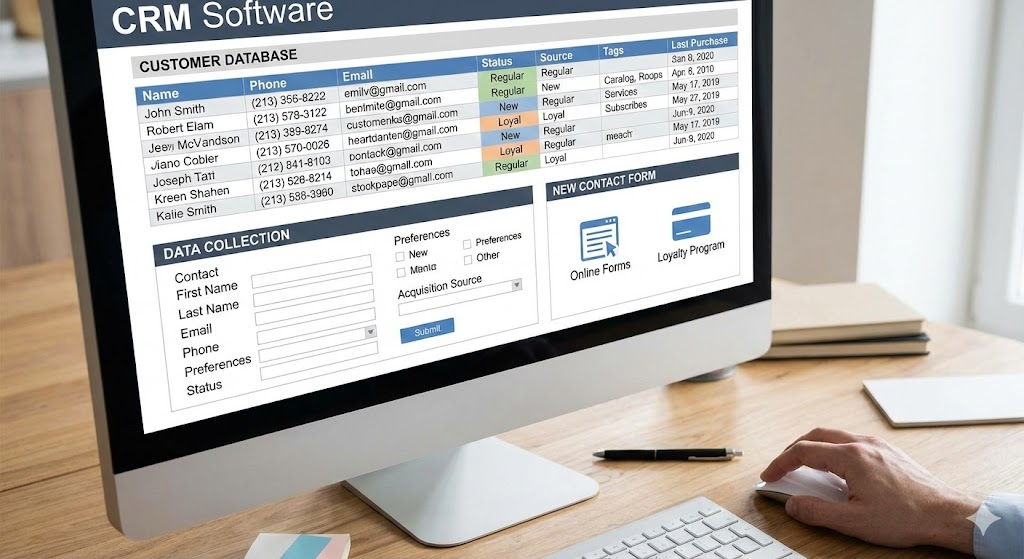
To create a customer base, you need to determine what data will be useful for your business. This usually includes:
- Contact information (name, phone, email)
- Purchase history (dates, amounts, goods)
- Acquisition source (through advertising, marketplaces, direct sales)
- Preferences and features (sizes, colors, product categories)
- Customer status (regular, new, loyal, potential)
Data structuring is the organization of information in a format that is convenient for analysis and search. Here it is important to ensure uniform entry (for example, a single phone format), customer segmentation by groups, and the creation of labels and tags.
Mobile applications of the CRM system HugeProfit


Use all the advantages of a mobile device for inventory management:
– mobile barcode scanner
– adding sales in 2 clicks
– creating and tracking TTN
– controlling balances on Prom, Rozetka, OpenCart, Woocommerce, Khoroshop
– Many warehouses and employees
How to collect a customer database: proven methods
- Online forms and subscriptions — allow visitors to your website, social networks, or marketplace to leave contacts through registration or subscription to news.
- Loyalty programs and bonuses — encourage customers to share their contacts in exchange for discounts and gifts.
- Order processing and offline points of sale — record customer data with every purchase.
- Integration with marketplaces and delivery services — automatic collection of information when interacting with external platforms.
- Analytical tools and activity monitoring — accumulate data from various channels and combine them into a single base.
The main secret of forming a base is not just collecting data, but getting “live” contacts that can be used for further interaction.
How to manage a customer database: modern approaches and tools
Today, there are several approaches to customer accounting: from simple spreadsheets to full-fledged CRM systems with analytics, reminders, and integration with messengers and telephony. The choice of tool depends on the scale of the business, the number of customers, and the tasks that need to be solved.
Customer accounting management using CRM and customer base management programs
What is CRM and why is it needed? CRM for customer base management is a specialized program that helps systematize buyer information, control the sales funnel, and automate communications. If you want to move away from the chaos of Excel and use digital technologies for business growth, CRM — the optimal solution.
Key advantages of using CRM for customer base management
- Data centralization: all customer data is collected in one place and available in real-time.
- Process automation: creating reminders, mailings, generating reports — everything is at hand.
- Integration with external services: marketplaces, delivery services, email, messengers.
- Analytics and segmentation: easily identify customer groups and create targeted marketing campaigns.
- Scalability: CRM grows with your business, allowing you to implement new functions and expand functionality.
HugeProfit, as a professional SaaS platform, offers exactly such a tool — easy to learn and flexible for small and medium-sized businesses.
Customer base management: CRM vs. traditional methods
Excel and paper lists are not designed to handle large volumes of data and do not allow for quick reactions to changes in customer behavior. A CRM system provides automatic data synchronization, prevents duplication, and facilitates employee collaboration.
Compare for yourself:
| Indicator | Excel/Manual Management | HugeProfit CRM System |
| Contact Management | Limited, manual | Full automation and search |
| Interaction History | None or fragmented | Detailed analytics |
| Integration with other services | None | Marketplaces, delivery, warehouse |
| Scalability | Complex | Flexible, adapts to growth |
| Errors and Duplication | Frequent | Minimal thanks to checks |
Thus, managing a customer base in a CRM is the path to professional and efficient customer accounting.
Functions and capabilities of CRM systems for customer accounting in product business
Most modern CRMs have functionality that is specifically suitable for e-commerce and retail. Let’s look at the key features using HugeProfit as an example.
Integration with marketplaces and delivery services. HugeProfit automatically synchronizes customer and order data from popular platforms such as Prom.ua, Rozetka, and WooCommerce. This simplifies customer base formation, minimizes manual entry, and speeds up order processing.
Automation of order and warehouse processing. CRM combines inventory accounting, generation of consignment notes (TTN), and shipment control. This allows for quicker reactions to demand changes and avoids errors in orders.
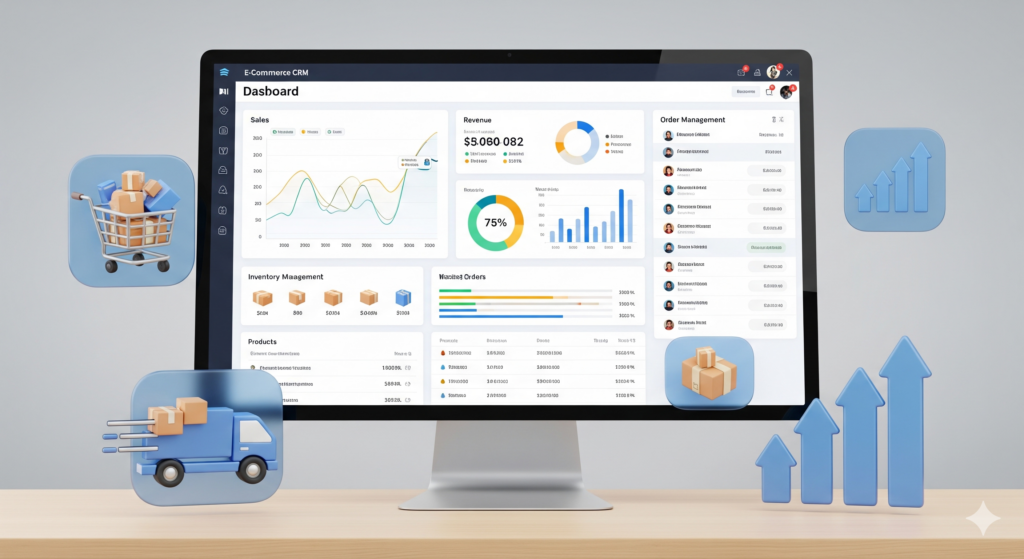
Financial analytics and stock control. Built-in reports show revenue, margin, average check, and customer activity. The administrator sees the full picture — which goods and customers bring maximum profit, and can make data-driven decisions.
Practical tips for working with a customer database in e-commerce and retail
Effective work with a customer database in e-commerce and retail directly affects sales, average check, and customer loyalty level. Unlike B2B, here it is especially important to consider purchase frequency, behavioral data, and customer preferences, as decisions are made faster and competition is higher. Properly constructed accounting of customer information allows not only to analyze demand but also to build personalized communications at every stage of interaction with the buyer.
How to properly manage customer accounting for profit increase
- Regularly update data. Do not allow information to become outdated — correcting numbers, addresses, and preferences is important for quality service.
- Monitor repeat purchases. Identify regular customers and incentivize them with bonus programs.
- Use personalization. Address them by name, suggest products based on order history.
Segmentation and personalization of the customer base for marketing
Segment customers based on parameters that influence purchasing behavior: age, geography, product category, purchase volumes. This will allow for targeted promotions and increase conversion.
The role of customer base analysis in business decision-making
Use reports to identify trends, seasonal fluctuations, and customer preferences. Analytics will help properly form the assortment, optimize inventory, and plan promotions.
How to choose and implement a customer base management program for small and medium-sized businesses
When choosing a program, pay attention to:
- User-friendly interface and a minimal learning curve for employees.
- Availability of integrations with marketplaces, delivery services, and accounting.
- Modules for warehouse accounting and financial analytics.
- Data security and technical support.
Step-by-step guide to transitioning from Excel to a CRM/ERP system
- Define the goals and objectives of customer accounting. What do you want to achieve with the new tool?
- Choose a suitable CRM. Give preference to reliable solutions, such as HugeProfit.
- Prepare your current data. Check and structure the base, remove duplicates.
- Set up integrations. Connect marketplaces and delivery services.
- Train staff. Conduct training and create instructions.
- Launch the system and monitor data quality. Analyze errors and adjust processes.
By choosing HugeProfit, you get a tool for comprehensive customer accounting and business automation that will help you reach a new level of efficiency and growth.
FAQ
Can I manage a customer base without a CRM, for example in Excel? Yes, but only at the initial stage. As the number of customers grows, Excel ceases to be convenient: duplicates, errors appear, and the interaction history is lost. A CRM system solves these problems through automation and centralized data storage.
What customer data is really important to store? Minimally — contacts and purchase history. For business growth, the acquisition source, order frequency, average check, and customer preferences are also important. This data allows for base segmentation and increased repeat sales.
Is a CRM suitable for a small business with a small number of customers? Yes. A CRM is especially useful for small businesses, as it helps establish correct processes immediately, not lose customers, and scale without chaos in accounting.
Can I automatically collect customers from marketplaces and an online store? Yes. Modern CRM systems, such as HugeProfit, automatically pull customer and order data from marketplaces and the website, forming a unified customer base without manual entry.
How does customer accounting affect profit growth? A structured customer base allows you to work with repeat sales, launch personalized offers, and plan marketing more accurately. As a result, conversion, average check, and customer loyalty increase.
