Table of Contents
As businesses grow and processes become more complex, companies increasingly face the problem of fragmented data, manual calculations, and a lack of a transparent view of financial and operational performance. Management accounting allows for the systematization of information on revenues, expenses, and departmental efficiency, and automation using CRM and ERP systems makes this process faster, more accurate, and more convenient.
What is Management Accounting and Why Your Business Needs It
Management accounting is a system for collecting, processing, and analyzing data necessary for effective company management. Unlike financial accounting, which is focused on external reporting, management accounting is intended for internal purposes: improving efficiency, controlling costs, and making informed management decisions.
If you have a small or medium-sized business in retail or e-commerce, management accounting is the key to understanding the real state of affairs. It allows you to track product inventory, control financial flows, and plan development. The goals and objectives of management accounting are to create a transparent business monitoring system, reduce operational risks, and increase profit.
Thus, management accounting is a tool that helps owners and managers see the real picture and make decisions based on reliable data.
Mobile applications of the CRM system HugeProfit


Use all the advantages of a mobile device for inventory management:
– mobile barcode scanner
– adding sales in 2 clicks
– creating and tracking TTN
– controlling balances on Prom, Rozetka, OpenCart, Woocommerce, Khoroshop
– Many warehouses and employees
Key Tasks and Metrics of Management Accounting in Retail and E-commerce
In the retail business and online commerce, management accounting is aimed at solving several important tasks at once. Let’s look at them in detail:
- Sales Management control of sales volumes, analysis of dynamics and seasonality, identification of leaders and lagging products.
- Inventory Control: timely replenishment of the warehouse and prevention of shortages or excess inventory.
- Financial Flow Analysis: monitoring of cash receipts and payments, identification of bottlenecks in cash discipline.
- Cost Optimization: accounting for all expenses to reduce cost of goods sold and increase profitability.
- Support for Business Decisions: generation of reports for strategic planning, investments, and expansion.
Cost Management and Cost of Goods Sold Analysis
One of the key aspects of management accounting is cost management. To increase profitability, it is important not just to account for expenses, but to deeply analyze their structure and identify opportunities for optimization.
The following types of costs are distinguished in management financial accounting:
- Direct costs (purchase of goods, raw materials)
- Indirect expenses (rent, salaries, logistics)
- Variable and fixed expenses
Controlling costs allows for timely action to reduce expenses and take the business to a new level of efficiency.
Management Reporting and Its Role in Business Decisions
Management accounting reports are not just tables, but a powerful tool for analysis and decision-making. In product businesses and e-commerce, the main types of reports include:
- Reports on goods movements in the warehouse
- Financial reports (profit, loss, cash flows)
- Reports on purchases and sales
- Analytics of residual and commodity stocks
- Reports on profitability and effectiveness of sales channels
Such information helps manage the business on a daily basis and adjust the strategy.
How to Organize and Implement Management Accounting Using a CRM System
Implementing management accounting is a difficult process, especially for small and medium-sized businesses, where accounting is often done in Excel or is irregular. However, automation with a modern CRM/ERP system significantly simplifies the task. Below is a systematic approach to organizing and implementing management accounting.
Analysis of Current Business Processes and Setting Accounting Goals
The first stage is a detailed analysis of current processes:
- Determining what data is currently being collected and how it is being used.
- Identifying gaps and problem areas in accounting and analytics.
- Formulating goals: for example, reducing costs by 10%, accelerating order processing, improving inventory control.
Without clear goal setting, automation will be ineffective.
Choosing the Right Automation System: Advantages of HugeProfit
For small and medium-sized businesses, ease of implementation and breadth of functionality are important. That is why we recommend HugeProfit — a CRM/ERP system specially created for automating product business in retail and e-commerce.
Key advantages of HugeProfit:
- A unified center for trade management —warehouse, sales, finance, marketplaces, and delivery in one interface.
- Ready-made integrations with Prom, Rozetka, WooCommerce and delivery services.
- Automation of creating waybills (TTN), reports, and cost of goods sold calculations without additional manual labor.
- Affordability for small businesses — minimum technical barriers and high launch speed.
- Support for scaling and analytics for business growth.
Staff Training and Launch Support
For successful management accounting, it is important that employees understand the new software and processes — this reduces errors and speeds up results. We care about our clients and:
- Provide training materials and webinars.
- Provide 24/7 technical support.
- Help customize processes for specific business tasks.
Such a comprehensive approach minimizes risks and makes the system transition smooth.
Management Accounting and Controlling: Advantages of an Integrated Approach
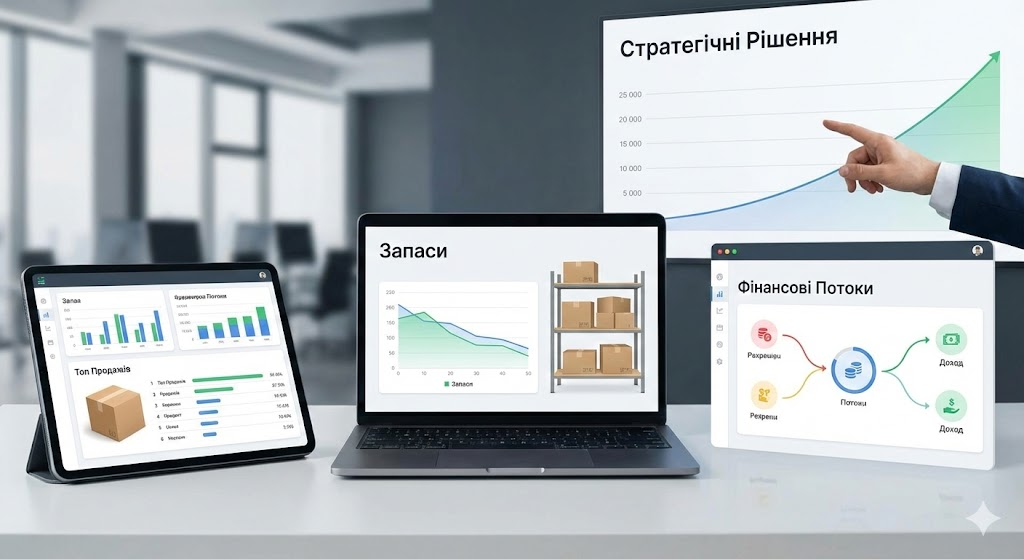
Management accounting and controlling are often viewed separately, but their synergy provides maximum benefit.
Controlling is a system of control and coordination of financial and management processes that complements management accounting with high-quality analytics, strategic planning, and forecasting.
An integrated approach allows you to:
- Get a complete “panoramic” overview of the business.
- Quickly identify deviations and optimize processes.
- Effectively manage resources and increase profit.
- Support long-term growth and scaling.
By using HugeProfit, you get a tool that combines management accounting data and controlling in a single system.
Key Documents and Reporting Automation in Management Accounting
For full-fledged management accounting, certain documents and reports are necessary to systematize business data. The list of main documents includes:
- Invoices and Waybills (TTN)
- Warehouse reports (inventory, goods movement)
- Financial reports (cash operations, revenues and expenses)
- Analytical reports on sales and purchases
- Reports on costs and cost of goods sold
HugeProfit automates the generation and storage of these documents, reducing manual labor and minimizing errors. The system generates electronic and printed versions convenient for control and reporting, which significantly saves time and resources.
Where to Start with Management Accounting in Retail and E-commerce
If you are considering implementing management accounting, we recommend adhering to the following plan:
- Assess the current accounting system — identify weak points and priority tasks.
- Set specific goals — for example, control inventory, reduce costs, or speed up order processing.
- Choose an automation tool with integration support (HugeProfit is an excellent solution).
- Set up accounting and reporting processes — assign responsible persons and define regulations.
- Train the team — ensure understanding of new tools and rules.
- Launch statistics and analysis — regularly check results and adjust decisions.
HugeProfit is ready to help you make this process easy and effective. Contact us for a consultation and start managing your business professionally today.
FAQ — Frequently Asked Questions about Management Accounting
What to choose for management accounting: Excel or a CRM/ERP system? Excel is suitable at the start, but as the business grows, it quickly becomes a source of errors and fragmented data. A CRM/ERP system automates data collection, generates real-time reports, and reduces dependence on manual operations.
Is management accounting mandatory for small businesses? Formally — no, but in practice, it helps small businesses control money, inventory, and profitability. Without management accounting, it is difficult to understand which products and sales channels are truly profitable.
How does management accounting differ from financial accounting? Financial accounting is focused on legal requirements and external reporting. Management accounting is created for the owner and management — it is flexible, customizable, and reflects the real picture of the business for decision-making.
How long does it take to implement management accounting in retail? The timeframe depends on the scale of the business and the level of automation. When using a ready-made CRM/ERP system like HugeProfit, basic management accounting can be launched in a few weeks.
Is it possible to manage accounting for multiple sales channels at once? Yes. Modern systems allow combining data from offline points, online stores, and marketplaces into a single set of analytics, which is especially important for e-commerce and omnichannel retail.
